
Most men who buy a suit spend their attention on the wrong things. Cloth, colour, the number of buttons and the price tag all get a long look. Fit, which does more than any of them to decide how a suit looks, gets a quick glance in a mirror and a shrug. That is a pity, because a modest suit that fits well will look better than an expensive one that does not, and because the checks are not difficult. They just have to be made in the right order.
The order matters because some parts of a suit can be adjusted easily and others cannot. Start with the ones that cannot.
The shoulders come first
Stand square to a mirror with the jacket buttoned and your arms relaxed at your sides. The shoulder seam, where the sleeve joins the body of the jacket, should end where your own shoulder ends. If it stops short, the jacket is too small; if it sits out beyond your shoulder, it is too big, and the sleeve will start to collapse or wrinkle below it.
Look for two warning signs. A dimple or divot in the sleeve head, the top of the sleeve where it meets the shoulder, suggests the shoulder is too narrow for you. A ridge of spare cloth along the shoulder line, or a shoulder pad that sticks out past your own, suggests it is too wide.
This is the first check because it is the hardest to change. Altering the shoulders of a tailored jacket is complicated, expensive and often not worth doing. If the shoulders are wrong, try another size or another cut. Everything else on the list can be corrected by someone with a needle.
Chest, waist and the closure
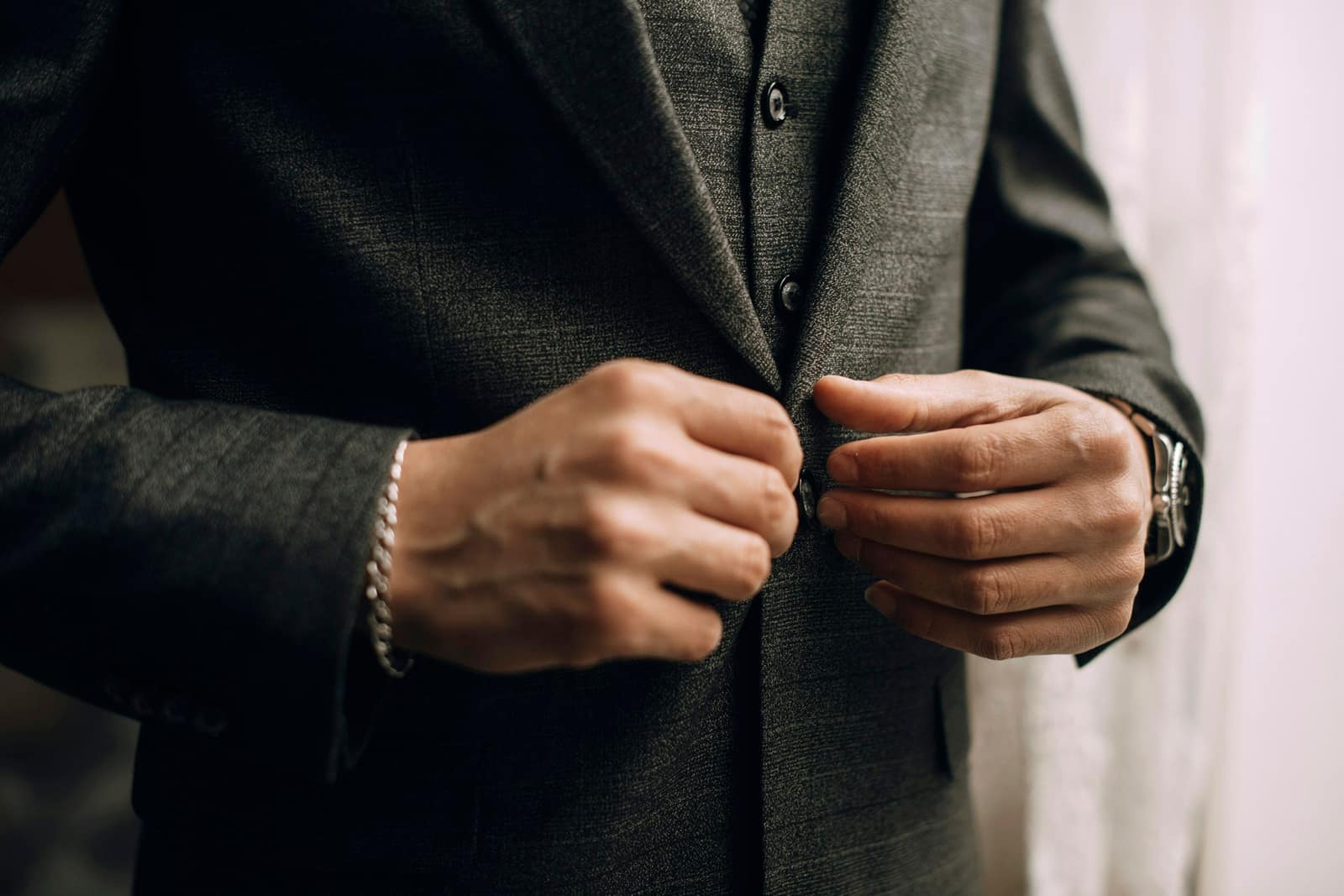
Fasten the jacket, using the middle button on a three-button jacket or the top button on a two-button one, and the rest, as a rule, stay undone. The jacket should close without strain and without pulling. If the fabric makes an “X” of tension lines radiating from the button, it is too tight across the chest or waist. If the front flaps open or the jacket looks boxy and hangs away from your body, it is too loose.
You should be able to slide a hand flat between the closed jacket and your shirt without difficulty, and put a fist in only with some effort. If you can move freely but there is no excess fabric, you are in the right place. Try reaching forward, as if to shake hands, and then folding your arms. A good fit allows both without the back seam straining.
The collar of the jacket should rest against the collar of your shirt, with no gap in between. A collar that stands off the neck, so you can see a gap at the back, suggests the jacket is not sitting properly, and it is a fault that is both visible and hard to fix.
Sleeves
With your arms at your sides, the jacket sleeve should end around the wrist bone, where it allows a little of the shirt cuff, usually about a centimetre or so, to show. The exact amount is a matter of taste, but the principle is that the cuff peeks out, and does not vanish into the sleeve or hang below it.
This is one of the easiest things to change. Sleeves can usually be shortened from the cuff by a tailor, provided the sleeve has enough fabric to turn up, and the cost is modest. A good tailor will also point out if the buttons would end up too close to the edge, which is the main limit.
Jacket length
Jacket length is the check that people most often get wrong, in both directions. A traditional guide is that the hem should cover your seat and fall roughly level with your knuckles when your arms hang naturally, but this is a rule of thumb rather than a law, and modern cuts vary. A shorter jacket is a deliberate style choice, and it suits some builds and not others. The question to ask in a mirror is whether the jacket looks balanced: not so short that it exposes the seat, nor so long that it swamps your legs.
Altering length is possible but limited, and often a bad idea, because the pockets, vents and proportions are set up for a particular length. As with the shoulders, it is usually better to find a cut that works than to try to rebuild one that does not.
Trousers
Trousers are the most forgiving part of a suit and the most often neglected. Three things matter.
The waist. They should sit comfortably on your natural waist or just below it and stay there without a belt doing all the work. A tailor can adjust the waist by a size or so, in or out, within the limits of the seam allowance.
The leg. The line should fall straight from the hip, without pulling across the thigh or flapping around the calf. A trouser that is too tight will show horizontal creases at the groin; one that is too baggy will pool fabric at the knee. The width of the leg is a question of style, and a gently tapered line suits most people.
The break. This describes the fold in the fabric where the trouser meets the shoe. A “no break” or slight break, where the hem just touches the shoe, is a clean, modern look. A fuller break, where the cloth folds more, is more traditional. Hems are among the simplest alterations and are usually made on a fitting appointment, once you know which shoes you will wear.
A short fitting-room routine
When you are trying a suit on, a sequence helps:
- Check the shoulders in the mirror, with the jacket fastened.
- Close the jacket and check the chest, waist and collar.
- Move. Reach forward, sit down, raise your arms, and see how the jacket behaves. A suit has to be worn, not just stood in.
- Check the sleeves and length last, because they can be changed.
- Ask a second opinion from the person selling you the suit or a friend, and look at the back as well as the front.
What a tailor can and can’t do
Alterations are part of buying a suit, not a sign that something is wrong with it. Off-the-peg suits are cut for an average body, and a few small adjustments often make the difference. Sleeve length, trouser hems, the waist of the trousers and a modest taking-in of the jacket body are all routine. Shoulders, collar and substantial changes to the jacket’s structure are not.
A reasonable approach is to buy for the parts you cannot change and alter the parts you can. If the shoulders and chest fit, almost everything else can be put right by someone who knows what they are doing.
The short version
Begin with the shoulders, check the closure and the collar, then the sleeves, then the length and trousers. Aim for a jacket that lets you move without looking loose, and trousers that follow your leg. Fit is a matter of proportion rather than formula, and your own judgement in front of a mirror is still the best measure.


