

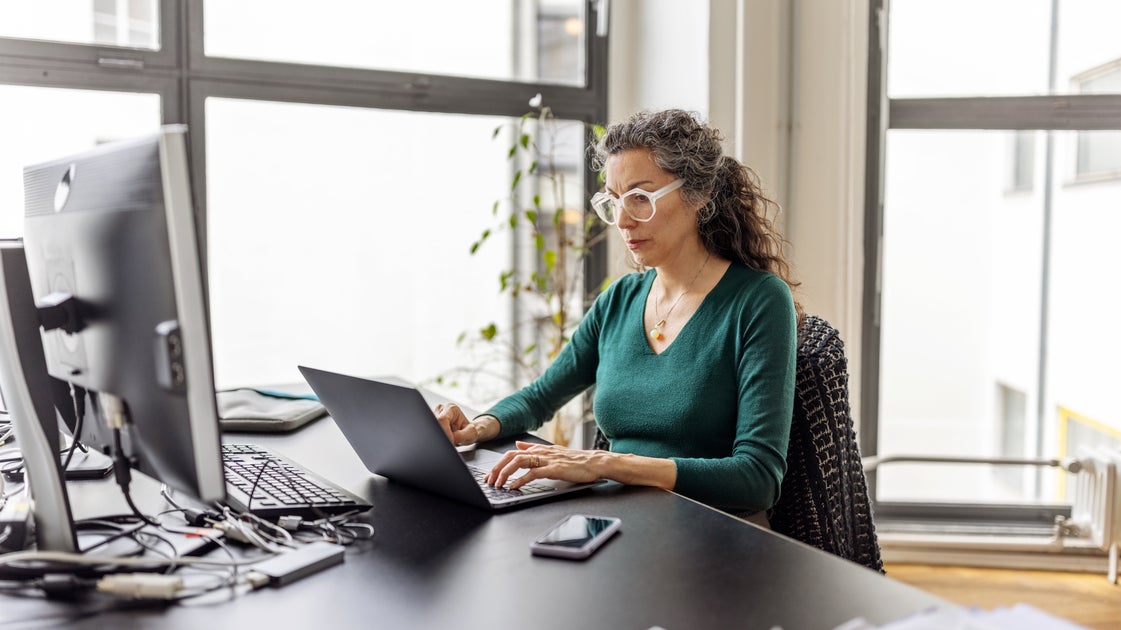
You may want to stand up and do a few stretches while reading this.
At this point, research has established that prolonged sitting is really harmful to our health. It’s linked to conditions like high blood pressure, heart disease and diabetes, but what if it’s also the reason for your back pain or that pesky knee pain that pops up every time you try to jog?
While there are multiple causes of back and knee pain, sitting all day at a desk job may be a major factor, too. Here’s what to know:
Sitting all day can cause tight hip flexors.
“A lot depends on how you sit, but essentially, prolonged sitting puts your iliopsoas, which is your primary hip flexor, into a shortened position,” said Dr. Michael Fredericson, a professor of sports medicine and the director of Stanford Lifestyle Medicine in California.
Your hip flexors are a group of muscles that allow you to raise your knee. You also use these muscles when you step up and bend forward.
“So if you’re staying in that position for seven, eight hours a day, then it becomes chronically tight into that position, and you get what we call passive muscle stiffness,” Fredericson said.
This isn’t only a problem for people who sit all day; it’s also common among runners and cyclists, said Brian Kracyla, a physical therapist and owner of Cloudline Physical Therapy in Philadelphia.
According to Melanie McNeal, physical and occupational therapy manager at Baylor College of Medicine in Texas, men are often affected.
“Most everyone has tight hip flexors, because we’re a society that does a lot of sitting, so it is a huge issue,” McNeal said. However, it tends to be even more prevalent in men “because males tend to be tighter than females on the whole.”
Luis Alvarez via Getty Images
Tight hip flexors can cause knee and back pain.
Why does it matter if you have tight hip flexors? Well, it turns out this issue could be causing pain and mobility problems that you probably aren’t even connecting to tight hips.
One problem people with tight hips may experience is knee pain, McNeal said, “because if your hip flexor is tight … it compresses your kneecap, your patella, and that can cause knee pain, especially with activity like jogging or running or fast walking.”
If you have tight hip flexors, your stride length will be shorter when walking and running, Kracyla said. This contributes to the shuffling gait that’s often seen in older adults.
Having tight hip flexors can also lead to posture issues and back pain.
“You’re going to have a pelvic tilt in the front, which is going to increase the curve of your spine in the back,” Kracyla said, “and often that will manifest itself on our end with lumbar extension compensation, so you could feel more low-back stiffness with activity due to your tight hip flexors.”
“That’s why a lot of times when you stretch the hip flexors, people’s back pain feels better,” Fredericson said.
If you can’t avoid sitting all day, there is a better way to sit.
A lot of people have desk jobs and long commutes that require them to sit for many hours of the day, and there is no way around that reality. While sitting all day long isn’t ideal for your hip mobility (and many other systems in your body), there’s a way to adjust.
The problem with sitting all day is the slouching and slumping that most of us do when we’re on our computers, tablets or phones, Fredericson said, “instead of actively using your core and postural muscles to keep your pelvis in a more neutral position.”
“When you’re slouched all day, those hip flexors are in this chronically shortened position, but if you look at people who maintain better posture, their pelvis is not … going into a posterior pelvic tilt. It’s staying in a more neutral position,” Fredericson added. This way, you’re engaging your muscles and participating in more “active sitting.”
Beyond maintaining good posture while sitting, it’s important to stand and move around for at least five minutes every half hour, according to Fredericson. This can look like going on a walk, heading downstairs for a snack, stretching or switching to your walking pad for a low-stakes call.
“Not only is that going to be good for your hip flexors and your flexibility, but it’s just good for your whole metabolic system,” Fredericson said. “We know the people who do that, their blood pressure is lower. They have less cardiovascular risk factors.”
Exercise can also help, but going to the gym after sitting for eight hours a day, five days a week, isn’t going to counteract your inactivity.
“You might get this false belief that you’re still staying in great shape because you go to that gym, but then you still sit all day — but it doesn’t really work like that,” Fredericson said.
This doesn’t mean your exercise regimen isn’t helpful. For optimal body function, you should practice good sitting posture, get up for movement breaks and follow an exercise regimen. Movement, in general, helps with everything.
“The more active we can be, the fewer problems we have,” McNeal said.
Treating tight hip flexors comes down to a multi-pronged approach, Kracyla added, including stretching, mobility work and strength training. According to the Hospital for Special Surgery, helpful stretches for tight hip flexors include the half-kneeling stretch and the 90/90 stretch. Child’s pose and low-lunge stretch can be beneficial, too.
It’s not enough to hold a stretch for 15 seconds and move on, though. McNeal said you should aim to hold each stretch for 30 seconds and repeat it three times.
If you notice pain or difficulty with movement or stretching, it’s worth talking to a doctor to see if you could benefit from additional support from a physical therapist.
“There is some nuance to it,” Kracyla said, before adding that it often requires a clinical eye to prescribe treatment.